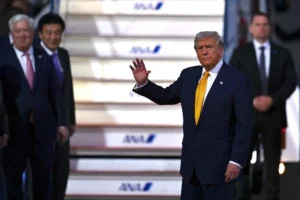
Daily Trending News in USA brings you major policy shifts unfolding right now in Washington D.C. As of October 31 2025, two pivotal developments dominate the headlines: the ongoing federal government shutdown now exceeding a month, and the U.S. military’s announced return to nuclear weapons testing. Each carries far-reaching implications for the economy, national security, and everyday Americans. In this post we’ll break down both stories in detail, explain what they mean for you, and highlight key factors to monitor in the coming days. Not financial advice.
Government Shutdown Escalates Filibuster in the Crosshairs
The federal government shutdown has now entered Day 31, becoming one of the longest in U.S. history. The Guardian+2Wikipedia+2
Key Facts
| Item | Detail | Why it matters |
|---|---|---|
| Day count | ~31 days without full funding. The Guardian+1 | Prolonged shutdown = deeper consequences. |
| SNAP / food aid risk | Roughly 42 million Americans may lose nutrition assistance soon. The Guardian+1 | Direct impact on low-income households. |
| Filibuster debate | Donald Trump has publicly urged ending the Senate filibuster to reopen funding. The Washington Post+1 | A major procedural shift in U.S. law-making could be triggered. |

Why It Matters
- Federal employees and contractors face unpaid work, which may reduce consumer spending and confidence.
- Essential services could be further delayed or curtailed, affecting sectors like health, research, national security.
- The political stakes are high: if resolution is further delayed, public backlash may influence upcoming elections.
What to Watch
- Will Congress override the filibuster or maintain existing Senate rules?
- How states respond, especially those gearing up to cover benefits like SNAP via emergency funds.
- Whether back-pay provisions will be tied into final funding legislation, and how that impacts morale.
2. U.S. Resumes Nuclear Testing Global Shockwaves
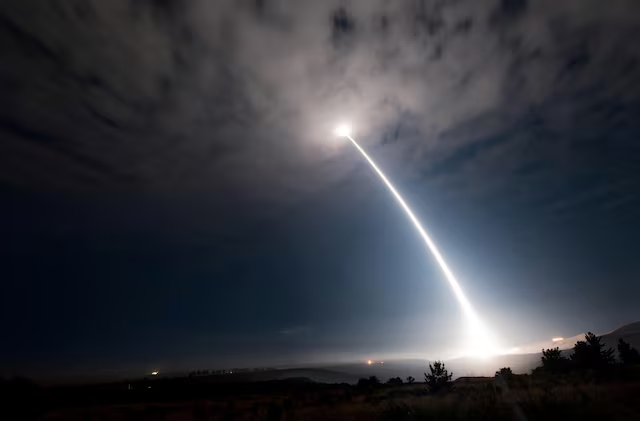
In a surprise announcement, President Trump directed the United States Department of Defense (DoD) to immediately resume nuclear-weapons testing after roughly 33 years. Reuters
Key Facts
| Item | Detail | Implication |
|---|---|---|
| Announcement timing | Issued October 30, 2025, just before the U.S.–China meeting. Reuters+1 | Raises questions about strategic motives. |
| Global reaction | Russia and China warned this could destabilize treaties. Reuters+1 | Potential arms-race or retaliatory escalation. |
| Testing ambiguity | It remains unclear if tests are explosive or missile/flight based. Reuters | Uncertainty increases risk and unknowns for markets/policy. |
Why It Matters
- Resumption of testing signals a shift in U.S. nuclear posture; adversaries may feel compelled to respond.
- Heightened geopolitical risk may impact global markets, defence spending, and investor sentiment.
- Domestic policy could shift as resources may be redirected and international treaty obligations re-examined.
What to Watch
- Will tests begin immediately, and what form will they take?
- How will China, Russia, the U.N., and allied nations respond diplomatically or militarily?
- Will treaty frameworks like the Treaty on the Non‑Proliferation of Nuclear Weapons (NPT) be renegotiated or undermined?
3. Economic Under-Currents: Confidence Slips Amid Uncertainty
While the headlines centre on politics and defence, economic signals quietly point to stress. The The Conference Board’s U.S. consumer-confidence index fell to 94.6 in October, driven by concerns over jobs and inflation. Reuters
Table: Consumer Confidence Snapshot
| Metric | October 2025 | Last Month | Note |
|---|---|---|---|
| Confidence Index | 94.6 | 95.6 | Six-month low |
| Job-availability concern | 27.8% expect fewer jobs | 25.7% | Rising pessimism |
| High-income (> $200k) | Stable/positive | N/A | Polarised economy |
Why It Matters
- Lower confidence can reduce consumer spending, slowing growth in services and retail.
- Job-market concerns may dampen hiring affecting wage growth, unemployment risk.
- Combined with political instability (shutdown) & defence shifts, the economic environment becomes more volatile.
What to Watch
- Will the Federal Reserve act on this data amid limited official reporting due to the shutdown? The Business Standard
- How companies adapt: will hiring freeze or cutbacks accelerate?
- Will households delay big purchases (homes, autos) due to uncertainty?
Internal & External Link Suggestions
- Internal link opportunity: “See our earlier post on federal shutdown impacts” (link to your own site).
- External links:
- Shutdown details: Wikipedia on 2025 U.S. federal government shutdown Wikipedia
- U.S.–China trade/meeting update: LiveMint article
FAQs
The Senate filibuster requires 60 votes to close debate and advance most legislation. By urging its elimination, Republicans would bypass this barrier and push funding bills without bipartisan support.
Not necessarily. Testing could be limited and part of a strategic signalling move. But it raises risks, as other nuclear states may respond, and international frameworks could be shaken.
Beyond federal employee paychecks, essential services like food assistance are at risk; states and beneficiaries may face disruptions, leading to stress for millions.
Conclusion
Daily Trending News in USA reflects a period of deep transformation: from the federal government’s inability to fund itself, to a pronounced shift in U.S. military doctrine via nuclear-testing resumption. These aren’t isolated events they affect labor markets, global relations, and economic stability. For U.S. audiences including employees, investors and everyday consumers the message is clear: stay alert, understand how these shifts touch your world, and prepare for continuing turbulence. Not financial advice.